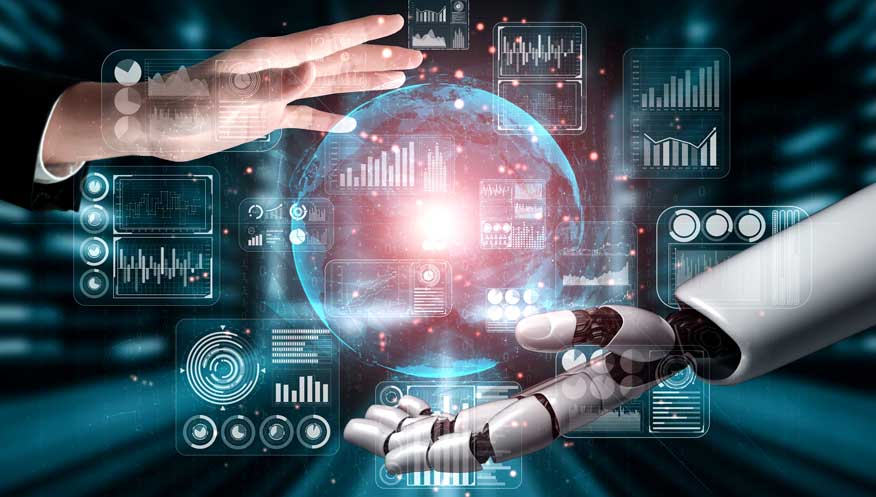
The rapid advancement of artificial intelligence and machine learning has set the stage for the future of cybersecurity, where the stakes are higher than ever before. In a time when the line between human and machine is becoming increasingly blurred, and the future of AI and its impact on cybersecurity is not just a matter of technology, but a battle for the very fabric of our digital existence.
Even though millions of personal records and credit card numbers are stolen by cybercriminals every year, people are more willing than ever to share their information online. In fact, 74% of consumers are willing to share more personal data if there were a benefit in it for them, such as a promotion or exclusive access to products or services.
The amount of private data shared online is vast, and it’s creating a problem for cybersecurity experts. When it comes to keeping personal information safe, is AI the problem or the solution? The answer just might be both.
Key Takeaways
- AI is reshaping both sides of the cybersecurity battlefield. Organizations are using machine learning to detect threats faster, while bad actors exploit the same tools to scale attacks like phishing and deepfakes.
- Cybersecurity defenses must evolve alongside expanding digital ecosystems. Cloud, IoT, and remote work environments are increasing the number of attack surfaces, making a unified, AI-driven defense strategy essential.
- Regulations and ethics will guide the responsible use of AI. Compliance with frameworks like GDPR and PCI DSS, and governance over third-party AI tools, will become central to building trust and reducing risk.
- Defense-in-depth strategies anchored in encryption and tokenization remain critical. Masking sensitive data at the point of entry reduces exposure and simplifies compliance in an era of increasingly sophisticated threats.
The Role of AI and Cybersecurity in Protecting Digital Assets
Artificial intelligence and machine learning are changing the world as we know it. From facial recognition technology to AI-powered cancer detection, the strength, speed and affordability of AI security stand to make our world a better place. Not only can AI remove the errors and costs that come with human labor, it can also analyze millions of data points at incredible speeds.
For cybersecurity experts, AI and machine learning are improving the efficiency and security of operations centers and expanding the skillsets of those working in the sector. These technologies also help organizations protect the many moving parts of their systems, from end-point devices to cloud infrastructure to omnichannel points of sale. In fact, 69% of organizations consider AI essential for thwarting cybersecurity attacks, given the increasing volume is rendering human analysts too slow to identify all of them.
Not only does AI allow cybersecurity experts to process vast amounts of data, it also allows them to predict threats.
The Role of Machine Learning in the Future of AI and Cybersecurity
While AI refers to the broader concept of machines being able to carry out tasks in a way that we would consider “smart”, machine learning is a specific application of AI that allows systems to learn and improve from experience without being explicitly programmed.
Machine learning is a crucial component in the future of AI and cybersecurity, as it enables AI systems to learn from vast amounts of data and adapt to new threats.
Rather than simply organizing data, machine learning actually learns from it and adapts. Based on the information it receives, machine-learning AI develops algorithms that detect anomalies and unusual activity that may point to a breach — and then develops a solution to decrease vulnerability. Whereas traditional technology relies on past data, machine learning uses data to improvise and take preventative measures.
One example of this is AI-powered behavioral analytics. Cybersecurity experts can use machine learning to analyze approved users’ behaviors, from their typing and scrolling patterns to log-in times. When the machine-learning AI detects unusual activity, it blocks suspicious users and raises a red flag for IT to investigate.
With constant improvement and evolution baked into its very nature, the future of AI and machine learning is seemingly limitless. As AI and cybersecurity technologies continue to grow and evolve in tandem, the two will become inextricably linked.
Hackers Love AI, Too
Unfortunately, cybersecurity experts aren’t the only ones turning to AI for its incredible power. The same features that make AI attractive to tech security also appeal to hackers, posing a significant challenge for AI security professionals and their organizations. As AI and cybersecurity technologies advance, malicious actors are finding new ways to exploit these tools for their own gain.
Take AI-powered phishing attacks for example. Thanks to AI, hackers no longer need to spend hours upon hours authoring and sending malicious messages to the inboxes of unsuspecting victims. They can now use AI to perform large-scale phishing schemes in record time, using machine learning to continually improve their fraudulent messages.
And now, AI-powered deepfake technology is taking phishing to the next level. Deepfakes are created using AI that uses real voice or video recordings to create fake videos and audio that are indistinguishable from the real thing.
While many fear that deepfakes will be used to replicate public figures and spread disinformation in the near future, this notorious technology is already being used for less glamorous but equally nefarious purposes. In 2023, there was a 30-fold increase in deepfake fraud attempts, significantly elevating the risk to US businesses that already experience nearly $5 million in annual losses due to phishing. Because it’s powered by AI, deepfake audio is much easier to generate than you might think, making it an inexpensive and easy tool for hackers to target unsuspecting victims.
On top of the newfound ease of social engineering schemes like phishing and the advancement of deepfake making fraudsters harder to detect, machine learning has also automated classic cybersecurity scams. Password hacking may sound rudimentary, but with the help of enhanced algorithms, hackers can generate likely passwords faster and more accurately. All in all, the same AI technologies that make mass data analysis a breeze for cybersecurity professionals are being exploited by the bad actors they’re protecting against.
As the intersection of AI and cybersecurity becomes increasingly complex, it’s clear that the battle against hackers will be fought on the frontlines of artificial intelligence. With cybercriminals exploiting AI to launch more advanced attacks, the future of AI and cybersecurity hangs in the balance. The need for cutting-edge AI security solutions has never been greater.
The Great Cybersecurity Arms Race
It’s a tale as old as time (or at least as old as tech): hackers and organizations are in an ever-evolving arms race, and AI as the central weapon. Who will win?
It all depends on who’s working harder and smarter. For organizations, defending against an AI-powered threat requires a defense-in-depth security strategy, including everything from regular employee training to high-tech machine-learning security solutions.
To stay ahead, savvy companies will implement AI security measures, simultaneously utilizing AI to bolster security while protecting against threats. When leveraged strategically, AI can make cybersecurity measures more accessible, affordable, and robust.
5 Trends Defining the Future of Cybersecurity
As AI evolves and digital ecosystems expand, cybersecurity is undergoing a profound transformation. What once centered on traditional network defenses now encompasses dynamic, AI-driven threats, cloud-native infrastructures, and a global regulatory landscape. Below are five trends shaping the future of cybersecurity that every organization should be watching closely.
- AI as Both a Weapon and a Shield
- Rise of AI-Powered Social Engineering
- Expansion of Attack Surfaces (IoT, Cloud, Remote Work)
- Compliance and Governance Will Drive Innovation
- Cybersecurity Talent & Automation Convergence
AI as Both a Weapon and a Shield
Artificial intelligence has become the defining dual force in modern cybersecurity empowering both defenders and attackers. While AI enables faster threat detection, predictive analytics, and automated response capabilities, it also allows hackers to scale attacks with precision. This arms race will intensify as both sides continue to adapt AI models in real time. The future of cybersecurity will hinge on how well organizations can out-innovate adversaries using the same underlying technologies.
Rise of AI-Powered Social Engineering
Social engineering attacks are evolving rapidly thanks to generative AI tools. From sophisticated phishing emails to deepfake audio and video, attackers are now mimicking trusted identities with unprecedented accuracy and scale. These threats bypass traditional security tools by targeting human psychology, making security awareness and behavioral detection more critical than ever. As synthetic media becomes more accessible, organizations will need new layers of verification and trust.
Expansion of Attack Surfaces (IoT, Cloud, Remote Work)
As digital ecosystems grow more distributed, so do the potential entry points for cyberattacks. From smart devices and IoT sensors to hybrid cloud infrastructures and remote work endpoints, today’s environments demand a broader security perimeter. This expansion increases risk and complicates visibility, requiring holistic solutions that unify data protection across channels and platforms. Expect to see greater investment in secure access service edge (SASE), zero trust architectures, and integrated data security platforms.
Compliance and Governance Will Drive Innovation
With regulations like PCI DSS 4.0, GDPR, and the evolving patchwork of U.S. state laws, cybersecurity is now tightly bound to regulatory compliance. But rather than a barrier, these mandates are pushing organizations to adopt more secure architectures like tokenization, P2PE, and orchestration to minimize liability and reduce scope. Proactive compliance is becoming a competitive differentiator, prompting innovation in privacy-preserving technologies and automation of audit workflows.
Cybersecurity Talent & Automation Convergence
The cybersecurity talent shortage continues to strain security operations, but automation is closing the gap. AI and machine learning are increasingly deployed to handle threat detection, policy enforcement, and routine incident response, freeing up human analysts to focus on complex investigations and strategy. This convergence won’t eliminate the need for skilled professionals, but it will redefine their role within AI-augmented security teams
How Governance and Regulation Will Shape AI’s Cybersecurity Role
As AI takes on a larger role in both defending and attacking digital systems, governance will become one of the most critical levers for managing its risks. From ethical deployment to third-party oversight and global regulation, cybersecurity is entering an era where compliance will be as important as code.
Ethical Use of AI in Cyber Defense
As security teams adopt AI tools to detect and respond to threats, questions around ethical use are coming into sharper focus. Organizations must ensure their AI models are transparent, bias-free, and not making high-stakes decisions (such as user access or fraud blocks) without human review. Cyber defense powered by AI must also avoid overreach in data collection or surveillance practices.
Third-Party Risk and Compliance Expectations
With AI tools increasingly being integrated from third-party vendors, businesses are under pressure to vet these solutions for data handling, model integrity, and security controls. Expect tighter requirements for documentation, auditability, and risk mitigation in vendor contracts, especially in regulated industries.
Global Regulations Like GDPR and AI Safety Acts
Policymakers worldwide are beginning to treat AI as a dual-use technology with the potential for harm. Regulations like the EU’s AI Act and existing frameworks like GDPR now intersect with cybersecurity strategies. Organizations deploying AI in cyber defense must prepare for compliance mandates around explainability, consent, and cross-border data handling.
Make Encryption Part of Your Defense-in-Depth Strategy
The best way to ensure that cyber thieves can’t get their hands on your data is by preventing clear-text data from ever entering your system. With a combination of tokenization and point-to-point encryption (P2PE), you can ensure that sensitive information is masked with tokens and encrypted at the point of sale.
At Bluefin, we specialize in PCI-validated P2PE, tokenization and other integrated solutions to protect your data from cybercriminals. If you’re looking to boost your defense-in-depth strategy and want to learn more about our security products, contact us today.
Future of Cybersecurity FAQs
What is the future of cybersecurity?
Cybersecurity is shifting toward AI-driven defenses, automation, and privacy-first frameworks. Organizations will need scalable, real-time solutions to counter evolving threats and meet growing compliance demands.
Will cybersecurity be replaced by AI?
No. AI will enhance cybersecurity, not replace it. While AI automates detection and response, human oversight is still essential for strategy, ethics, and complex decision-making.
How does machine learning improve cybersecurity?
Machine learning detects patterns, flags anomalies, and adapts to new threats in real time. It enables faster, smarter defense than traditional rule-based systems.
What are examples of AI cyberattacks?
Common AI-driven attacks include phishing emails crafted by generative models, deepfake scams, and automated password cracking powered by machine learning.