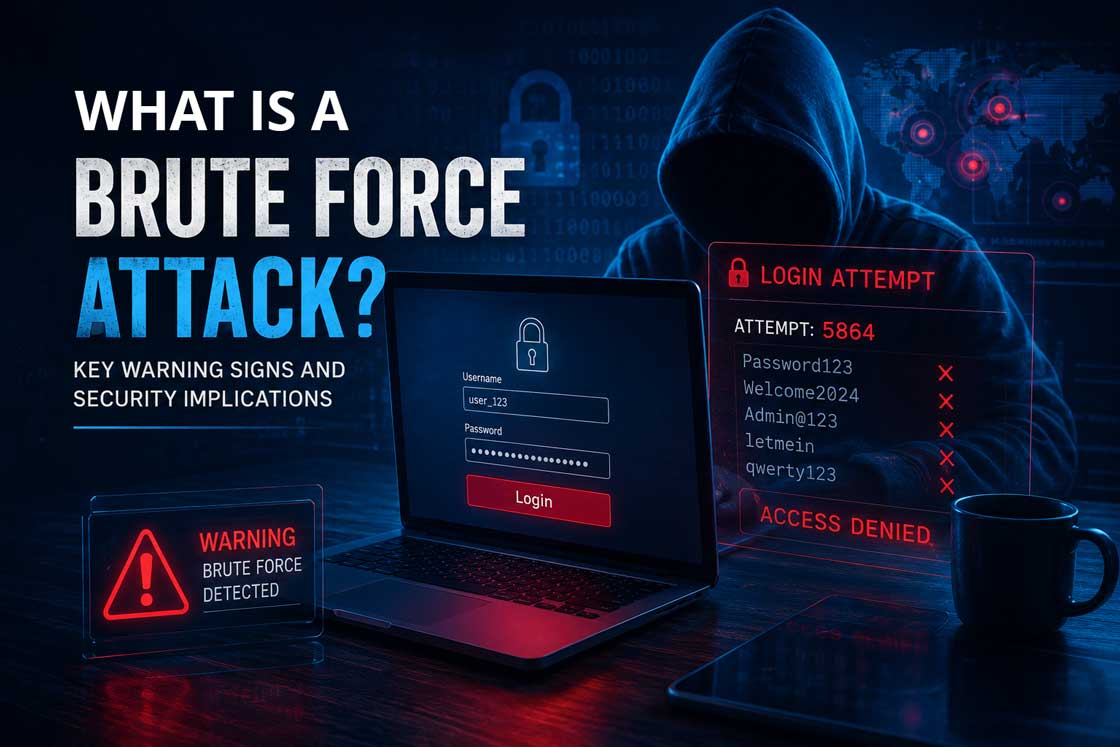
Known as one of the oldest types of attacks, brute force attacks are on the rise due to the shift to remote work. Hackers use trial-and-error to guess login info, encryption keys, or find a hidden web page, working through all types of combinations in hopes of guessing correctly – gaining access into a network.
While the concept is simple, modern brute force attacks often rely on automated tools that can test thousands, or even millions, of credential combinations in a short period of time. Successful attacks can lead to account takeovers, data theft, malware deployment and broader network compromise.
Understanding what a brute force attack is, how it works and the different techniques attackers use can help organizations strengthen their security posture and better protect sensitive data from unauthorized access.
What Is a Brute Force Attack?
A brute force attack is a cyberattack in which an attacker uses trial-and-error methods to guess passwords, login credentials, encryption keys or other authentication information until the correct combination is found.
Brute force attacks are one of the oldest and most common attack methods used by cybercriminals. Rather than exploiting a software vulnerability, attackers rely on repeated login attempts to gain unauthorized access to accounts, applications or networks. Modern brute force attacks are often automated, allowing attackers to test thousands, or even millions, of password combinations in a short period of time.
These attacks commonly target:
- User accounts
- Administrator credentials
- Remote access systems
- Web applications
- Email platforms
Once successful, a brute force attack can give attackers access to sensitive data, financial information and internal systems. In some cases, attackers use compromised accounts to deploy malware, steal data, install backdoors or launch additional attacks.
While brute force attacks can be highly effective against weak passwords and poorly secured accounts, security measures such as multi-factor authentication (MFA), account lockout policies and strong password requirements can significantly reduce their success rate.
How Does a Brute Force Attack Work?
A brute force attack works by systematically testing usernames, passwords or encryption keys until the correct combination is found. Rather than relying on sophisticated exploits, attackers use persistence and automation to gain unauthorized access to systems and accounts.
A typical brute force attack follows these steps:
1. Identify a Target
An attacker selects an account, application, website or network they want to access.
2. Generate Credential Guesses
Using automated tools, the attacker attempts large numbers of username and password combinations. These guesses may be based on common passwords, leaked credentials or randomly generated combinations.
3. Repeated Login Attempts
The attack tool continuously submits credentials to the target system, testing each combination until a valid match is found.
4. Gain Unauthorized Access
If the correct credentials are discovered, the attacker can access the account or system and begin exploring the environment.
5. Exploit the Compromised Account
Once inside, attackers may steal sensitive information, escalate privileges, deploy malware or establish persistence for future attacks.
Modern brute force attacks can perform thousands of login attempts per minute, making weak passwords particularly vulnerable. For this reason, organizations often implement security controls such as multi-factor authentication (MFA), account lockout policies and login monitoring to detect and prevent brute force activity before an account is compromised.
Types of Brute Force Attacks
Not all brute force attacks are conducted the same way. While the goal is typically to gain unauthorized access to an account or system, attackers use different techniques depending on the information they have available and the security controls they are trying to bypass.
Simple Brute Force Attacks
A simple brute force attack involves manually guessing usernames and passwords until the correct credentials are found. Attackers often rely on commonly used passwords, personal information or predictable password patterns. While relatively unsophisticated, simple brute force attacks can still succeed when weak passwords are used.
Dictionary Attacks
Dictionary attacks use automated tools to test large lists of commonly used words, phrases and passwords against an account or system. Instead of trying every possible combination, attackers focus on passwords that people frequently choose, making dictionary attacks faster and more efficient than traditional brute force methods.
Credential Stuffing
Credential stuffing occurs when attackers use usernames and passwords obtained from previous data breaches to attempt logins on other websites and applications. Because many users reuse passwords across multiple accounts, credential stuffing can be highly effective even when the targeted organization has not experienced a breach itself.
Password Spraying
Password spraying takes the opposite approach of traditional brute force attacks. Rather than trying many passwords against a single account, attackers test a small number of commonly used passwords across a large number of accounts. This helps attackers avoid account lockout mechanisms that trigger after multiple failed login attempts.
Reverse Brute Force Attacks
In a reverse brute force attack, the attacker starts with a known password and attempts to find usernames that match it. For example, a cybercriminal may use a password exposed in a previous breach and test it against thousands of potential usernames or email addresses in an effort to identify valid account combinations.
Understanding the different types of brute force attacks can help organizations implement more effective security controls and detect suspicious login activity before an account is compromised.
How to Prevent Brute Force Attacks
While brute force attacks remain a common cybersecurity threat, organizations can significantly reduce their risk by implementing layered security controls. Combining strong authentication practices with proactive monitoring can make it much more difficult for attackers to gain unauthorized access to accounts and systems.
Use Multi-Factor Authentication (MFA)
Using multifactor authentication (MFA) is critical.
“MFA adds another layer of security to your password. Requiring a password in conjunction with biometrics or something you have, such as a unique token, helps to limit the effectiveness of brute-force attack,” Brent Johnson, Bluefin’s CIO, says.
Additionally, other steps, like setting up a “honey-pot” account may help.
“These are fake account(s) that only a select few admins know about within an environment,” he explained.
Enforce Strong Password Policies
Weak passwords are one of the primary reasons brute force attacks succeed. Organizations should require strong passwords that are long, unique and difficult to guess. Encouraging employees and users to avoid password reuse can further reduce risk.
Limit Login Attempts
Restricting the number of failed login attempts can help stop automated brute force attacks before attackers have an opportunity to test large numbers of credential combinations. Many organizations implement temporary delays or rate-limiting controls after repeated login failures.
Monitor for Password Spraying
Password spraying attacks often target many accounts using a small number of common passwords. Monitoring authentication logs for unusual login patterns can help security teams identify these attacks early and respond before accounts are compromised.
“These admins are alerted anytime someone tries to log in to that account. This method is effective in finding threat actors in your environment ‘password spraying’ user accounts trying to find a match.”
Use Account Lockouts
Account lockout policies temporarily disable access after a defined number of failed login attempts. This helps prevent attackers from continuously guessing passwords against a single account and can significantly slow automated attacks.
Deploy Threat Detection Tools
Security monitoring and threat detection solutions can help organizations identify suspicious authentication activity, unusual login behavior and credential attacks in real time. Early detection allows security teams to investigate and respond before attackers gain access to sensitive systems or data.
By combining these security measures, organizations can significantly reduce the likelihood of successful brute force attacks and better protect sensitive information from unauthorized access.
How Bluefin Uses Encryption to Protect Sensitive Data
Encryption cannot prevent a brute force attack from occurring, but it can help limit the damage if an attacker successfully gains access to a system or account.
When sensitive data is encrypted, it is converted into an unreadable format that can only be accessed with the appropriate decryption key. As a result, even if an attacker compromises an account through a brute force attack, encrypted data remains significantly more difficult to exploit.
Encryption is particularly important for protecting:
- Payment card data
- Personally identifiable information (PII)
- Protected health information (PHI)
- Financial records
- Customer account information
Organizations should implement encryption both at rest and in transit to help protect sensitive information throughout its lifecycle. Encrypting data stored in databases, applications and backups can reduce the value of stolen information, while encryption in transit helps prevent unauthorized access as data moves between systems.
For stronger protection, many organizations combine encryption with technologies such as tokenization and multi-factor authentication (MFA). Together, these controls help reduce data exposure and strengthen defenses against credential-based attacks, including brute force attacks.
While preventing unauthorized access remains the primary goal, encryption provides an important additional layer of security by helping ensure that sensitive data remains protected even if an attacker successfully breaches an account or network.
Strengthen Your Security Posture with Bluefin
Brute force attacks remain one of the most common methods cybercriminals use to gain unauthorized access to systems and sensitive data. While strong passwords, multi-factor authentication and threat monitoring are critical defenses, protecting the data itself is equally important.
Bluefin helps organizations secure payment data, PII and PHI through encryption and tokenization solutions designed to reduce data exposure across complex environments. By protecting sensitive information at every stage of the data lifecycle, organizations can strengthen security, reduce risk and improve resilience against evolving cyber threats.
Learn how PCI-validated point-to-point encryption (P2PE) helps protect sensitive payment data and reduce data exposure across your environment.
Brute Force Attack FAQs
Is Brute Force Phishing?
No. Brute force attacks and phishing attacks are different types of cyberattacks. A brute force attack relies on repeatedly guessing passwords or credentials until the correct combination is found, while phishing uses deceptive emails, messages or websites to trick users into revealing sensitive information.
How Do Hackers Guess Passwords?
Hackers often use automated tools to test large numbers of password combinations. They may rely on common passwords, dictionary words, leaked credentials from previous data breaches or personal information that can be found online. Weak or reused passwords are particularly vulnerable to these attacks.
How Long Does a Brute Force Attack Take?
The length of a brute force attack depends on factors such as password complexity, computing power and security controls. Weak passwords can sometimes be cracked in minutes, while strong, unique passwords with sufficient length may take years, or longer, to guess successfully.
What Is Password Spraying?
Password spraying is a type of brute force attack in which attackers test a small number of commonly used passwords across many different accounts. This approach helps attackers avoid account lockout policies that may be triggered by repeated failed attempts against a single account.
Can MFA Stop Brute Force Attacks?
Multi-factor authentication (MFA) is one of the most effective defenses against brute force attacks. Even if an attacker successfully guesses a password, MFA requires an additional form of verification, such as a mobile device, biometric scan or security token, before access is granted.
What Is the Difference Between Credential Stuffing and Brute Force Attacks?
A traditional brute force attack attempts to guess passwords through repeated trial and error. Credential stuffing, by contrast, uses usernames and passwords that have already been exposed in previous data breaches. Attackers test these stolen credentials across multiple websites and applications in hopes that users have reused the same password.