The Challenge of Omnichannel Payment Orchestration
Retailers operate in one of the most complex payment environments today. Customers expect seamless payment experiences across in-store, ecommerce, mobile, call center and emerging digital channels. Supporting this level of omnichannel payment orchestration requires retailers to connect payment providers, customer data and transaction workflows across every touchpoint.
Omnichannel payment orchestration gaps remain, with issues such as vendor lock-in, unprotected entry points, fragmented customer data, and high compliance costs, all while fraud and regulatory pressure continue to grow.
Omnichannel payment orchestration provides merchants a smarter way to manage payments by securing every entry point, unifying fragmented customer data, and eliminating vendor lock-in. With encryption and tokenization at its core, this approach reduces compliance scope and risk while giving retailers the flexibility to scale, switch providers, and innovate with confidence.
Bluefin’s Chief Revenue Officer, Drew Monroe, explains why more companies are adopting multi-processor payment strategies and how payment orchestration turns complexity into opportunity.
Key Takeaways
- Omnichannel payment orchestration helps retailers manage payments across in-store, ecommerce, mobile and call center channels.
- Traditional orchestration platforms often overlook card-present environments and omnichannel security requirements.
- Bluefin’s ShieldConex® Orchestration helps secure payment data across every customer touchpoint.
- Retailers gain greater flexibility, lower compliance burden and stronger omnichannel payment security.
Why Omnichannel Payment Orchestration Matters
As retailers expand across in-store, ecommerce, mobile and other digital channels, payment operations become increasingly complex. Customers expect a seamless experience regardless of how they choose to engage, while retailers must manage payment data, security, and compliance across a growing number of systems and touchpoints. Omnichannel payment orchestration helps bridge these challenges by connecting payment experiences, customer identities and security controls across the entire payment ecosystem.
Customers Expect Consistent Payment Experiences
Today’s customers move fluidly between channels. They may research products online, complete purchases in-store, use mobile applications for account management or interact with call center representatives for support. As a result, customers increasingly expect payment experiences to be consistent across every touchpoint.
Omnichannel payment orchestration helps retailers deliver a unified checkout experience by supporting consistent payment methods, loyalty programs and transaction workflows regardless of where the interaction occurs. This consistency can improve customer satisfaction while reducing friction throughout the buying journey.
Payment Data Must Follow the Customer Across Channels
Retailers often struggle with fragmented payment and customer data spread across multiple systems. When transaction information exists in separate channel-specific environments, it can become difficult to build a complete view of customer activity.
Omnichannel payment orchestration helps connect payment data across channels, creating greater visibility into customer interactions and purchasing behavior. Through technologies such as tokenization, retailers can securely associate transactions across touchpoints without exposing sensitive payment information, enabling more effective loyalty, personalization and customer engagement initiatives.
Security Must Extend Across Every Touchpoint
Every payment channel introduces potential security and compliance challenges. In-store terminals, ecommerce checkouts, mobile applications and call centers each represent unique entry points where sensitive payment data may be collected, transmitted or stored.
Omnichannel payment orchestration helps retailers apply consistent security controls across the entire payment ecosystem. By leveraging technologies such as PCI-validated point-to-point encryption (P2PE) and vaultless tokenization, organizations can protect sensitive data across channels, reduce PCI scope and strengthen payment security regardless of where a transaction originates.
Retail Omnichannel Payment Orchestration with ShieldConex®
That’s where ShieldConex Orchestration comes in: a purpose-built solution that applies these principles to the complex realities of modern retail. Built with PCI-validated P2PE, vaultless tokenization, and a cloud-native design, ShieldConex gives merchants full control over how they secure, route, and share payment and customer data.
Here’s how it works:
Protected Point of Entry: Data is encrypted the moment it enters through a POS terminal, mobile app, iFrame, or API with PCI-validated P2PE and vaultless tokenization in retail environments.
True Processor Freedom: Retailers control their tokens and can switch providers without costly detokenization fees.
Support for Every Transaction Type: Both in-store and eCommerce payments are supported across 120+ P2PE-enabled devices.
Unified Customer Identity: A universal token follows each customer across channels, connecting data into loyalty, CRM, and analytics platforms.
Built to Scale: A cloud-native architecture ensures low latency and global agility.
Lower Compliance Scope: ShieldConex enables retailers to streamline PCI DSS compliance, reducing scope by up to 90% while ensuring support for GDPR, CCPA, HIPAA, and NACHA.
Benefits of Retail Omnichannel Payment Orchestration for Retailers
By adopting ShieldConex, retailers can:
- Deliver consistent customer experiences across in-store, ecommerce, mobile and call center channels, creating a seamless payment journey regardless of where a transaction occurs.
- Unify payment and customer data through a single orchestration layer, reducing silos and improving operational efficiency.
- Gain cross-channel visibility into transactions, payment performance and customer interactions across the entire payment ecosystem.
- Establish a persistent omnichannel customer identity using universal tokenization, enabling loyalty, personalization and customer insights without exposing sensitive data.
- Secure omnichannel payments with PCI-validated P2PE and vaultless tokenization across every customer touchpoint.
- Minimize PCI scope and reduce compliance burden by limiting where sensitive payment data exists within the environment.
- Eliminate vendor lock-in while retaining ownership and control of customer and payment data.
- Scale more efficiently by adding new payment providers, channels and customer experiences without overhauling existing infrastructure.
In short, omnichannel payment orchestration helps retailers connect customer experiences, payment operations and security strategies across every channel while maintaining the flexibility needed to grow and adapt.
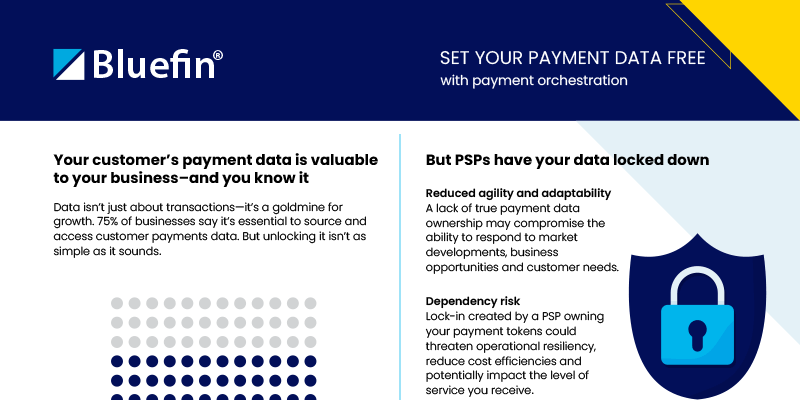
Check out some quick stats on how payment orchestration reduces complexity, increases flexibility, and provides freedom from vendor lock-in.
How Bluefin Can Help
Bluefin is a global leader in retail omnichannel payment orchestration and data security. Specializing in PCI DSS compliance for retailers, we help secure billions of transactions annually with PCI-validated P2PE, vaultless tokenization, and advanced orchestration, reducing compliance scope by up to 90%.
Still have questions on why data security matters in omnichannel payment orchestration? Check out our FAQs below.
You can also download Bluefin’s whitepaper – Putting Data Security First in Payment Orchestration – and learn how vaultless tokenization and encryption empowers businesses to reduce vendor lock-in, retain control of their payment data, and fuel global expansion.
Ready to protect your omnichannel payments and customer data? Contact Bluefin today to learn how ShieldConex Orchestration can transform your approach to omnichannel payment orchestration and secure transaction management.
Retail Omnichannel Payment Orchestration FAQs
What is omnichannel payment orchestration?
Omnichannel payment orchestration is the process of managing and securing payment transactions across multiple customer touchpoints—including in-store, ecommerce, mobile and call center channels—through a centralized platform. It helps organizations unify payment operations, customer data and security controls while maintaining a consistent experience across every channel.
Why is retail payment orchestration important for omnichannel retailers?
Omnichannel retailers need to process payments across web, mobile, in-store, and call centers. Retail payment orchestration enables a consistent, secure experience across all touchpoints while reducing vendor lock-in, improving flexibility, and centralizing data for better customer insights.
What are the most common security risks in retail payments?
Retailers face threats like card-not-present (CNP) fraud, data breaches, malware on POS systems, and phishing attacks that target employee or customer information.
How does point-to-point encryption (P2PE) protect retail transactions?
P2PE encrypts card data at the point of interaction and keeps it encrypted until it reaches a secure decryption environment, making it unreadable to fraudsters even if intercepted.
How does tokenization enhance retail payment orchestration?
Tokenization replaces sensitive card data with non-sensitive tokens. Within retail payment orchestration, this helps unify customer data across channels, reduce PCI scope, and ensure data security without storing raw card details.
How does retail payment orchestration reduce chargebacks and fraud?
By routing transactions through the most reliable processors and layering tokenization, P2PE, and fraud tools like 3D Secure, retail payment orchestration reduces false declines, improves authorization rates, and shifts liability to help prevent chargebacks.
How does omnichannel payment orchestration improve customer experiences?
Omnichannel payment orchestration helps create a seamless payment experience by connecting customer interactions across channels. Whether a customer shops online, in-store or through a mobile app, retailers can support consistent payment methods, unified loyalty experiences and streamlined checkout processes while maintaining visibility into the entire customer journey.
What Is the difference between payment orchestration and omnichannel payment orchestration?
Payment orchestration focuses on managing payment providers, gateways and transaction routing through a centralized platform. Omnichannel payment orchestration extends these capabilities across multiple customer channels, connecting payment data, customer identities and transaction experiences across in-store, ecommerce, mobile and other touchpoints. This broader approach helps organizations deliver a more unified customer experience while maintaining security and operational flexibility.