Key Takeaways
- Payment orchestration connects and coordinates multiple payment providers through a unified infrastructure layer.
- Orchestration allows businesses to choose the best payment provider for each transaction based on cost, geography, resilience, and other factors.
- Adding more payment providers gives businesses greater flexibility, but also creates more access points that must be secured.
- Effective payment orchestration builds data protection into the payment environment while preserving the flexibility to change providers and payment strategies as needed.
Just as customers today have more ways to pay – from buy now, pay later (BNPL) programs to in-app purchases – merchants also have more flexibility. Instead of relying on a single payment service provider, businesses can coordinate many different payment relationships to route transactions more efficiently and at lower cost.
Known as payment orchestration, this approach gives merchants greater control over increasingly interconnected payment environments.
What Is Payment Orchestration?
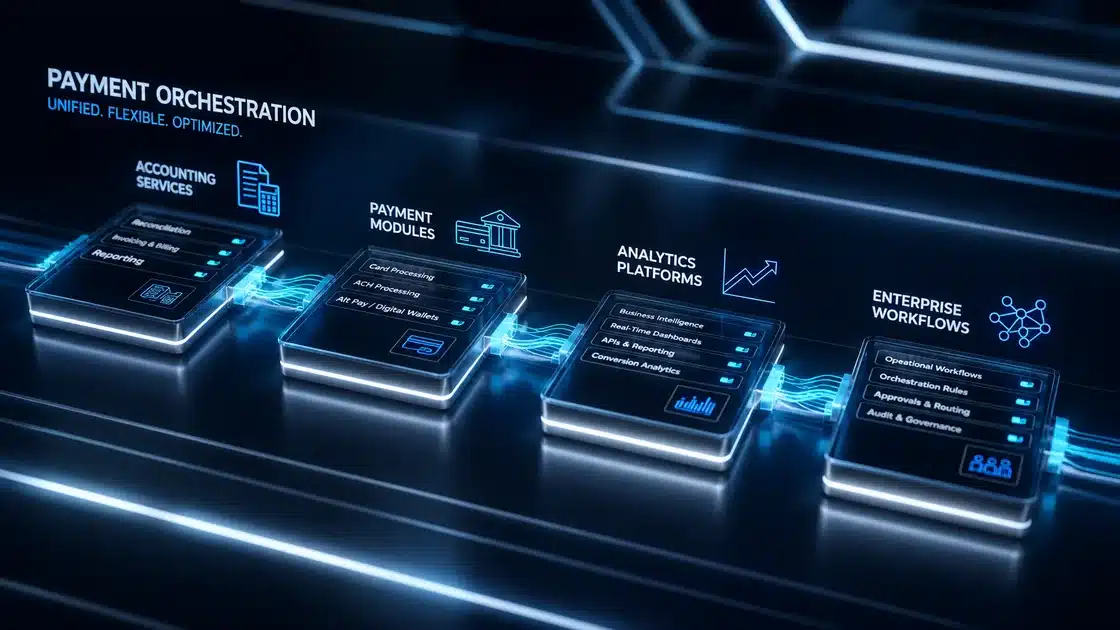
Payment orchestration is the process of connecting and coordinating multiple payment providers to direct each transaction to the best available route. These participants may include:
- Payment service providers (PSPs): Companies that allow merchants to accept and manage electronic payments.
- Payment gateways: Technologies that transmit transaction information between merchant systems and payment processors.
- Acquirers: Financial institutions that process card transactions for merchants.
- Processors: Providers that facilitate transaction messaging and authorization between merchants, acquirers, and payment networks.
- Fraud, identity, and data-security providers: Services that evaluate risk or protect sensitive information throughout the transaction lifecycle.
Why Payment Orchestration Has Become Essential
Today’s businesses often need multiple payment providers to support different markets, regulations, payment methods, and business priorities. Relying on a single provider can also create operational risk in case of outages or performance issues.
Payment orchestration helps businesses optimize payments by providing:
- Routing flexibility: Organizations can easily switch between providers based on geography, currency, cost, or other factors.
- Resiliency: If a disruption affects one payment provider, automated failover can redirect transactions to an alternative provider.
- Vendor independence: Merchants can change providers and negotiate relationships instead of being constrained by the policies of one vendor.
The Hidden Cost of More Connections
While payment orchestration offers organizations more choice, it also expands the transaction ecosystem and the security and governance that come with it.
More APIs Create More Security Dependencies
Payment orchestration often requires businesses to connect with more providers through APIs. As those connections grow, so does the work required to manage integrations and maintain security.
Token Environments Become More Difficult to Govern
Tokens are substitutes for sensitive payment data that allow businesses to process transactions without repeatedly handling the original card details. As companies add providers, they can end up with token sprawl – multiple token types, each with its own rules and vaults – that limits flexibility and complicates routing across providers.
Credentials and Authentication Requirements Multiply
As the payment ecosystem grows, so does the burden of managing access and protecting additional security credentials.
Payment Data Flows Through More Systems
In an interconnected orchestration environment, the transaction journey can involve many components that add exposure points where sensitive data could be exposed.
Governance Complexity Increases Across the Ecosystem
As more providers become involved, businesses need stronger third-party oversight to provide clearer operational governance and risk management that accounts for the entire payment ecosystem.
The Security Conversation Is Lagging Behind
Most payment orchestration conversations focus on four factors: conversion that turns more payment attempts into completed purchases, routing that selects the best provider for each transaction, processing economics that control fees and costs, and authorization rates that increase the percentage of transactions that are approved.
These factors are important, but an equally pressing issue is data protection. As sensitive information moves across more systems, interoperability creates new risks and transaction exposure increases while governance becomes more difficult.
Why Data in Motion Matters
Sensitive Data Is Moving Through More Systems
A transaction can interact with PSPs, gateways, orchestration platforms, and other partner ecosystems. To reduce risk, organizations need to consider every handoff and minimize the number of systems that receive sensitive data.
Protecting Stored Data Is No Longer Enough
Data can be exposed while moving between systems, so sensitive information must be protected from the moment it’s captured and throughout the transaction journey.
Transaction Ecosystems Require Embedded Security
Security controls are most effective when they are designed into the infrastructure and applied within the transaction flow itself, not added only after the infrastructure is already in place.
Building Future-Ready Transaction Infrastructure
A strong payment architecture should support new providers and transaction routes without requiring sensitive data to be exposed or security controls to be rebuilt.
Vendor-Agnostic Interoperability Enables Flexibility
Keeping security independent of any one provider makes it possible for businesses to grow their ecosystem, adding or changing partners without getting locked in.
Token Portability Supports Long-Term Agility
When tokens are portable, without ties to a specific provider, businesses can more easily add or change partners without rebuilding their token environment.
Governance Must Scale With Complexity
As payment orchestration grows more complex, businesses need clear oversight of how transactions are routed and who is accountable for protecting them at each stage.
PCI Scope Reduction Is Becoming a Strategic Priority
Reducing the number of systems that handle payment data can lower the risk of exposure and simplify PCI compliance, the security requirements businesses must follow when they accept, process, or store card information.
Protecting Data in Motion Supports Long-Term Trust
By protecting payment data as it moves between systems, organizations can add resilience to their operations and strengthen customer trust over time.
How Bluefin Helps Secure Payment Orchestration
Rather than adding security as another service on top of a routing platform, Bluefin builds it into the orchestration infrastructure itself.
Secure Sensitive Data Before It Moves
Bluefin’s PCI-validated point-to-point encryption (P2PE) encrypts payment data at the point of transaction and keeps it unreadable until it reaches an approved decryption environment. The service, called Decryptx®, allows processors, gateways, and software platforms to provide P2PE without building and managing the underlying encryption infrastructure themselves.
Support Modern Payment Infrastructure
Bluefin also offers ShieldConex®, a vaultless tokenization solution that replaces payment data, personally identifiable information (PII), and protected health information (PHI) with format-preserving tokens. This protects sensitive data while allowing businesses to continue using it across existing applications and workflows.
Enable Secure Interoperability
Bluefin’s ShieldConex Orchestration® brings PCI-validated P2PE and vaultless tokenization together in one infrastructure layer so businesses can protect sensitive data consistently across the entire payment ecosystem. It also supports processor independence and token portability, so businesses can change providers or add new connections without replacing devices, migrating tokens, or rebuilding their security controls.
Secure Payment Devices Without Rebuilding Integrations
Bluefin’s TrustConex™ lets businesses deploy PCI-validated P2PE and card-present orchestration across more than 120 PCI-certified devices across 17 manufacturers. Acting as an intermediary between payment devices and processors – also known as a no-code proxy – TrustConex™ protects data in motion and can also tokenize payment data for secure reuse, all without requiring businesses to rewrite applications or change message formats and processor connections.
Reduce PCI Scope Across Transaction Ecosystems
By encrypting and tokenizing payment data before it reaches downstream systems, Bluefin simplifies compliance and narrows PCI scope, the parts of a business’s technology environment that must meet payment-card security requirements.
Why Secure Payment Orchestration Starts With Bluefin
Payment orchestration helps organizations create more flexible, resilient, and efficient payment ecosystems. But as transaction environments become increasingly interconnected, organizations must also address the security, governance, and data protection challenges created by expanding transaction ecosystems.
Bluefin helps organizations protect sensitive data in motion through encryption-first architecture, vaultless tokenization, and PCI scope reduction strategies designed for modern payment infrastructure.
Learn how Bluefin helps secure payment orchestration and protect sensitive data across complex transaction ecosystems.
Payment Orchestration FAQs
What is the difference between a payment gateway and a payment orchestration platform?
In simple terms, a payment gateway provides a transaction route, sending information from a merchant’s environment to a processor or acquiring service. A payment orchestration platform manages a network of routes connecting to multiple payment providers
Does payment orchestration replace payment gateways?
No. Payment orchestration doesn’t replace payment gateways but instead connects and coordinates multiple gateways so merchants can choose among them.
Why does data in motion matter in payment orchestration?
Payment orchestration connects multiple payment providers, which means sensitive data moves through more systems as it is collected, transmitted, and processed. Each additional touchpoint creates another place where that data must be protected.
What is token portability in payment orchestration?
Token portability is the ability to use a token across multiple partner environments instead of restricting it to one vendor’s ecosystem. This gives merchants more flexibility to route transactions and make changes to their payment ecosystem without replacing their tokens.
How can organizations secure payment orchestration environments?
Organizations can secure payment orchestration environments by combining P2PE, tokenization, and centralized data policies across the payment infrastructure.