
For enterprises, organizations, and SaaS platforms looking to expand into new markets, introduce diverse payment methods, and enhance customer experiences, multi-Payment Service Provider (PSP) tokenization has become an essential strategy.
A one-size-fits-all PSP model may suffice initially, but as organizations scale, the need for multiple PSP relationships becomes essential to:
- Support multiple geographies with region-specific payment options.
- Ensure omnichannel payment acceptance across e-commerce, mobile, and in-store environments.
- Optimize transaction costs by leveraging the most cost-effective PSPs for different scenarios.
- Introduce innovative payment experiences, such as pay-by-link or tap-on-mobile.
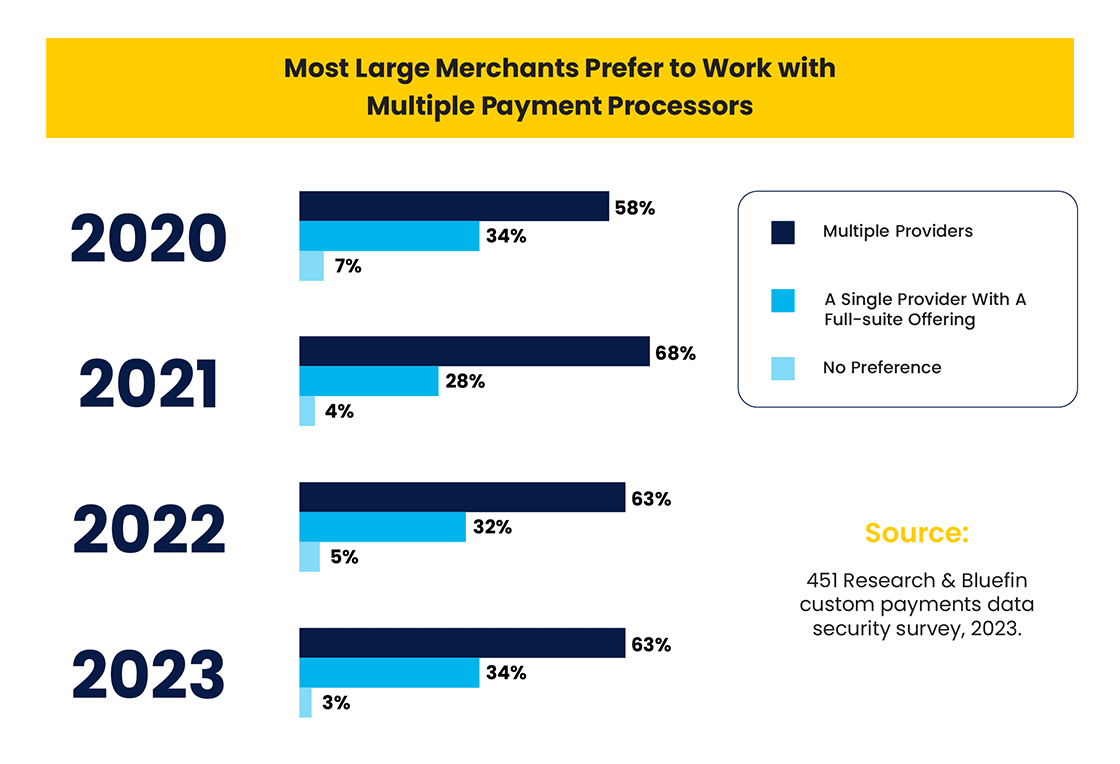
As reported in Bluefin and 451 Research’s white paper, The Strategic Importance of Payments Data Ownership, this demand for flexibility is evident – nearly two-thirds (63%) of merchants with over 1,000 employees prefer using multiple processors, citing better geographic reach and cost efficiency as key factors.
Key Takeaways
- Multi-PSP tokenization allows organizations to manage payment credentials across multiple payment service providers (PSPs).
- PSP-agnostic tokenization helps reduce vendor lock-in by keeping payment credentials independent of any PSP.
- Combining multi-PSP and PSP-agnostic tokenization comes with many benefits, including greater payment flexibility, data ownership, and support for long-term payment orchestration.
- An independent tokenization solution, such as ShieldConex® Orchestration, helps businesses scale multi-PSP strategies while strengthening payment and data security.
What is Multi-PSP Tokenization?
Multi-PSP tokenization is the process of managing cardholder data across multiple Payment Service Providers (PSPs). By replacing sensitive card numbers with portable tokens, organizations have greater flexibility to add or change PSPs, adapt payment strategies, and expand into new markets. When enabled by PSP-agnostic tokenization, multi-PSP tokenization reduces vendor lock-in by ensuring credentials remain portable regardless of which PSP processes the transaction.
What is PSP-Agnostic Tokenization?
PSP-agnostic tokenization is an independent approach to tokenization that is not linked to any single payment service provider. Instead of using a single processor’s token vault and proprietary tokens, businesses can use a secure, vaultless tokenization solution to store data that can be used across multiple PSPs. This allows for greater control over payment data and provides flexibility for multi-PSP strategies.
Why Multi-PSP Tokenization Requires PSP-Agnostic Tokenization
While expanding PSP relationships is crucial, businesses must also consider how they manage their payments data. Traditional PSP-driven tokenization, while aiding PCI DSS compliance, often locks businesses into a single provider, limiting agility and increasing switching costs. This dependency on PSPs for data security can create significant operational risks. As a result, organizations may not fully realize the benefits of their multi-PSP strategy.
To overcome these challenges, PSP-agnostic tokenization becomes crucial as it stores credentials independently of one provider, and grants organizations full control over their payments data. By moving the credentials independently of the PSP, organizations can easily change providers and support long-term payment orchestration without disrupting customer experiences.
What are the Benefits of Multi-PSP Tokenization with PSP-Agnostic Tokenization?
When combined with PSP-agnostic tokenization, multi-PSP tokenization provides organizations with greater payment flexibility, improved data protection, and increased control over payment data. Instead of relying on a single PSP, organizations can retain ownership of payment credentials and route transactions through the appropriate PSP.
Key benefits of multi-PSP tokenization include:
- Reduced PSP lock-in by managing credentials separately from a single PSP.
- Strengthened payment and data security through credit card tokenization, replacing sensitive cardholder data with portable tokens.
- Greater data ownership through an independent tokenization solution.
- Centralized token management across multiple PSPs.
- Simplified payment orchestration by allowing payment credentials to be used across multiple providers.
- Support for PCI DSS compliance by reducing the exposure of sensitive cardholder data and instead using secure tokens.
How to Implement a PSP-Agnostic Tokenization Solution
Organizations looking to implement PSP-agnostic tokenization typically have two main options:
- Build an in-house card data management infrastructure
- Requires compliance with PCI DSS certifications.
- Demands significant operational and security investments.
- Poses risks associated with internal storage of sensitive payment data.
- Only 21% of businesses today feel “very confident” in their ability to protect customer payment data, as highlighted by 451 Research and Bluefin surveys.
- Partner with a third-party tokenization provider
- Offloads compliance and security burdens while maintaining data ownership.
- Ensures portability and accessibility of payment data across multiple PSPs.
- Eliminates costly and complex data migrations when switching providers.
For most enterprises, organizations, and SaaS platforms, an independent tokenization provider offers the best balance between security, compliance, and flexibility. By using a third-party tokenization service, businesses can tokenize payment data in a PSP-agnostic manner, ensuring control without sacrificing convenience.
The Path to Greater Payments Autonomy
As the payments landscape continues to evolve, businesses must rethink their PSP strategies. A multi-PSP approach, combined with PSP-agnostic tokenization, empowers companies to:
- Enhance market expansion efforts without PSP constraints.
- Reduce dependency risks and improve redundancy.
- Optimize payment processing costs and improve transaction success rates.
- Maintain full ownership of customer payment data, ensuring long-term agility.
By embracing these strategies, enterprises, organizations, and SaaS platforms can future-proof their payment operations and position themselves for sustained success in an increasingly dynamic digital economy.
Learn More about ShieldConex® Orchestration
As organizations adopt multi-PSP strategies, they need a secure, PSP-agnostic way to maintain ownership of data while reducing vendor lock-in. ShieldConex® Orchestration provides a comprehensive, vaultless tokenization solution that enables businesses to take control of their payments data while ensuring seamless security and compliance. With ShieldConex®, organizations can centralize token management, support PCI DSS compliance, and simplify payment orchestration.
Ready to build a multi-PSP tokenization strategy? Contact Bluefin to learn how ShieldConex® can help your organization strengthen payment and data security and unlock payments autonomy.
Multi-PSP Tokenization FAQs
What is the difference between multi-PSP tokenization and PSP-agnostic tokenization?
Multi-PSP tokenization is the process of managing payment credentials across multiple payment service providers (PSPs). On the other hand, PSP-agnostic tokenization completes this process by keeping payment credentials independent of any single processor. When paired together, they give organizations greater flexibility and payment data ownership.
Why do businesses use multiple payment service providers (PSPs)?
Organizations use multiple PSPs to improve payment flexibility, modernize payments, support regional payment methods, optimize transaction costs, and ensure omnichannel payment acceptance. A multi-PSP strategy also helps businesses expand into new markets while improving payment performance and customer experiences.
Does multi-PSP tokenization improve payment data security?
Yes, multi-PSP tokenization improves payment data security by allowing organizations to securely manage payment credentials across multiple PSPs. When used with PSP-agnostic tokenization, sensitive cardholder data is replaced with secure portable tokens to strengthen security and control.
Can businesses switch payment processors without replacing customer payment tokens?
If payment credentials are stored using a PSP tokenization solution, switching providers may require re-tokenizing customer payment data. Instead, organizations can utilize a PSP-agnostic tokenization solution to maintain portable payment credentials and simplify processor migrations.
What is vendor lock-in in payment processing?
Vendor lock-in in payment processing occurs when businesses become dependent on a single payment service provider, making it difficult to switch providers. Pairing a multi-PSP strategy with PSP-agnostic tokenization helps reduce vendor lock-in by separating payment credentials from any single processor.